Skip to content


In crushed stone loading and transport, knowing the cargo’s weight does not tell you its volume. A weighbridge measures weight, but volume measurement is also needed for a fuller picture of each load. To address this, the client sought an automated solution that could measure truck load volume and allow staff to cross-reference the results with existing weight data.
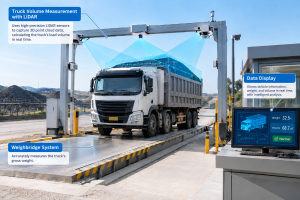
ViLiDAR provided a static LiDAR-based truck volume measurement solution. Integrated with the client’s existing weighbridge workflow, the system scans empty trucks at the entry station and loaded trucks at the exit station. The volume and weight data can then be checked together.
Project Background and Site Layout
A mining client in China wanted to add automated truck volume measurement to its existing transport process. The site had two weighbridge lanes. ViLiDAR installed custom overhead gantries at the exit station to support the LiDAR scanners, license plate recognition (LPR) cameras, and LED displays.

System Configuration
- Entry station (Empty truck scan): One volume measurement system and one LPR camera record the initial scan data for each empty truck bed.
- Exit station (Loaded truck measurement): Two measurement systems, two LPR cameras, and two LED displays serve the site’s two weighbridge lanes. The systems scan loaded trucks and display the results.
- Existing infrastructure: The client’s weighbridges and control cabin continue to handle weighing, data verification, and ticket printing. The existing weighbridge infrastructure and basic operating process remain in place.
| Equipment | Entry Station | Exit Station |
| Static truck volume measurement system | 1 set | 2 sets |
| License plate recognition (LPR) camera | 1 unit | 2 units |
| LED information display | — | 2 screens |
| Custom overhead gantries | — | 2 sets |
System Workflow
1. Empty Truck Scanning at the Entry Station
The empty truck stops at the designated position on the entry weighbridge. The LPR camera recognizes the license plate, while the overhead LiDAR scans the truck bed and records its spatial data. The truck is weighed according to the site’s existing procedures.

2. Crushed Stone Loading
After the empty-truck scan and weighing are complete, the truck enters the crushing plant where a wheel loader fills the bed.

3. Loaded Truck Measurement at the Exit Station
The loaded truck stops on one of the exit weighbridge lanes. The LiDAR scans the truck bed, and the system compares the loaded scan data with the truck’s initial empty scan to calculate the volume of the crushed stone load.
The LPR camera recognizes the license plate, and the corresponding measurement result appears on the LED display.

4. Data Verification and Ticketing
After the loaded truck has been scanned and weighed, the weighbridge operator checks the LiDAR volume data against the weighbridge weight data. Once confirmed, the operator prints a transport ticket with the volume and weight information using the existing ticketing process.
Project Benefits: Coordinating Volume and Weight Measurement
Automated Load Volume Measurement
The non-contact LiDAR measurement process does not require personnel to enter the truck bed. In this project, the system calculates load volume by comparing the empty and loaded scan results.
Integration with the Existing Weighbridge Workflow
The LiDAR volume data can be checked against the weighbridge weight data within the existing transport workflow. The solution does not require changes to the existing weighbridge infrastructure or basic operating process.
Measurement on Two Weighbridge Lanes
To serve the site’s two exit lanes, the project uses two independent LiDAR measurement systems, one for each lane.
Vehicle Recognition and Result Display
The LPR camera recognizes each license plate, and the exit LED display shows the corresponding measurement result for site personnel and drivers to view.
Frequently Asked Questions
Q1: Does static LiDAR truck volume measurement require the vehicle to stop?
Yes. In this project, the truck stops in a designated scanning area so the overhead LiDAR can complete its scan.
Q2: Why scan both the empty and loaded truck?
In this project, the system compares scans of the empty and loaded truck bed to calculate the volume of the material loaded. The empty scan records the truck bed’s initial state; the loaded scan records its state after loading.
Q3: Can a LiDAR system work with an existing weighbridge?
Yes. In this project, the gantries and equipment were installed above the client’s existing weighbridge lanes. The weighbridge continues to measure vehicle weight, while the LiDAR system measures load volume.
Q4: Can the system be deployed across multiple weighbridge lanes?
Yes. The number of systems can be configured to suit the site layout and number of lanes. In this project, measurement equipment was installed on both exit lanes.
Q5: Which bulk materials can the LiDAR system measure?
The system can be configured to measure materials such as crushed stone, sand, ore, and coal. The final configuration depends on material characteristics, vehicle dimensions, and site installation conditions.
ViLiDAR Truck Volume Measurement Solutions
ViLiDAR specializes in LiDAR-based volume measurement for bulk materials, with solutions for mines, quarries, ports, and industrial transport. Static and dynamic systems are available, with options for LiDAR scanning, LPR, and LED displays.
For a new project or an existing weighbridge site, equipment configurations can be tailored to the site conditions, vehicle dimensions, and operating requirements.
If you are looking for a truck volume measurement solution for a mine or quarry, contact ViLiDAR. Our engineers offer a free preliminary assessment to see if our LiDAR systems fit your site’s requirements.