 Skip to content

——Case Study: Vi-LiDAR LiDAR Volume Measurement System Empowers Crane Intelligence at Greenmei Sulfur Warehouse
Executive Summary
In sulfur warehousing and industries like steel, coal, waste management, ports, and logistics, cranes play an irreplaceable role. As industries transition toward smart, unmanned operations, LiDAR technology has emerged as a game-changer. By reducing single-operation time by half and doubling task frequency, LiDAR significantly boosts production efficiency. Greenmei (a leading sulfur warehousing enterprise) deployed our LiDAR-powered Autonomous Crane System, achieving zero annual safety incidents and drastically cutting occupational diseases. This article reveals how LiDAR solves critical challenges in sulfur warehousing: “material identification delays,” “inaccurate grabbing,” and “high-risk operations.”
Ⅰ.Challenges: Four Pain Points of Traditional Manual Sulfur Cranes
Operational Context
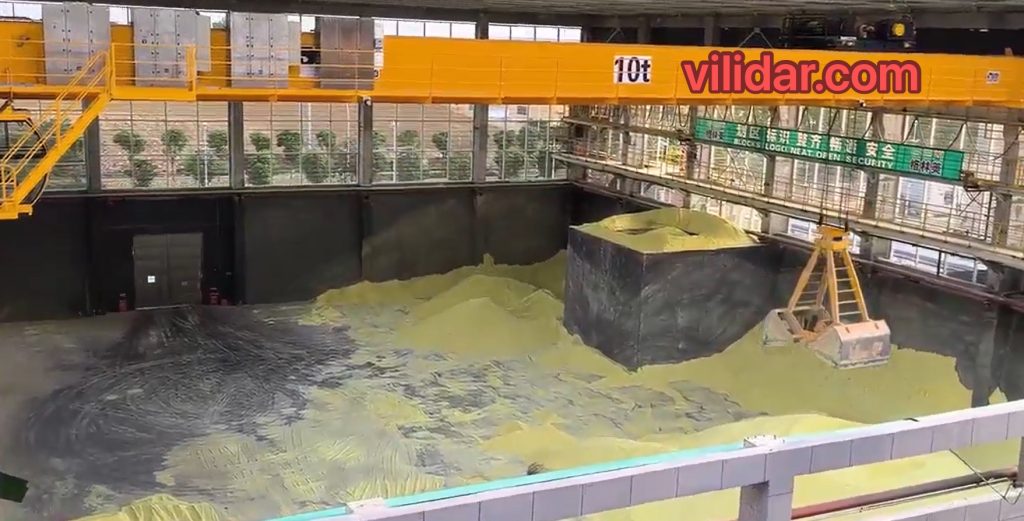
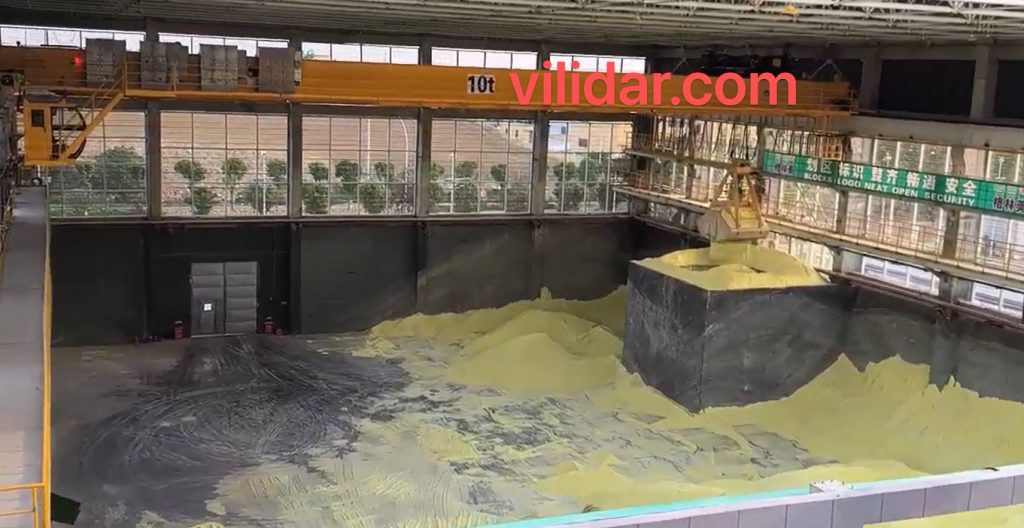
Greenmei’s sulfur warehouse spans tens of thousands of square meters, storing 100,000 tons of sulfur via heavy-duty cranes. Manual operations faced critical limitations:
Core Limitations
- Physical Inertia: Grab buckets swung excessively during target search, delaying positioning.
- Low Efficiency in Positioning: Irregular sulfur piles made manual targeting slow and error-prone in dusty environments.
- Skill Dependency: New operators required months of training, slowing overall productivity.
- Safety & Environmental Risks:
- Sulfur releases toxic gases (e.g., SO₂) when heated, with dust explosions risking lives.
- Frequent human inspections in hazardous zones elevated injury risks and insurance costs.
Ⅱ.Solution: Vi-LiDAR LiDAR-Powered Autonomous Crane System
Why LiDAR? ( LiDAR-powered Autonomous Crane System )
LiDAR’s non-contact 3D sensing, millisecond response, and robust anti-interference make it ideal for sulfur’s dusty, variable, and high-risk environment:
- Automated Recognition: Real-time 3D point cloud reconstruction of sulfur piles for precise targeting.
- Precision Grabbing: Volume algorithms optimize grab efficiency.
- Safety Shielding: Instant alerts for personnel intrusion via LiDAR and infrared.
System Architecture (Greenmei Case)
Hardware
- LiDAR: Mounted on crane beams (CP-L80 model: 270°×180° FOV, ±2cm accuracy at 30m).
- 10t Crane: Gantry crane with LiDAR sensors to prevent overload.
- Safety Modules: Dual LiDAR + infrared detection for full coverage.
Software
- 3D Point Cloud Algorithms ( 3D scanning ): Segments sulfur piles, calculates volume/center of gravity.
- AI Dispatch System: Plans optimal “identify-grab-place” paths.
- HMI Interface: Visualizes 3D models, trajectories, and alerts.
Workflow
- 3D Scanning: LiDAR maps sulfur piles, generating volume/location data.
- Dynamic Path Planning: Matches cargo space for minimal movement.
- Automated Execution: Grips and places sulfur with precision.
- 24/7 Operation: Continuous workflow in extreme conditions.
Ⅲ. Results: Efficiency & Safety Transformation
Qualitative Breakthroughs
- Efficiency Leap:
- Eliminated trial-and-error grabbing, doubling throughput.
- Safety First:
- Zero accidents from collisions or gas leaks.
- Reduced dust exposure by 90%, mitigating occupational diseases.
- Smart Management:
- Real-time 3D databases replaced manual logs.
- Predictive alerts minimized downtime.
- Uninterrupted Operations:
- LiDAR’s dust-penetrating scans enabled 24/7 reliability.
Ⅳ. Client Testimonial
“Vi-LiDAR transformed our operations—15% efficiency gains and safer workflows.”
— John Zhang, Technical Lead, Greenmei Sulfur Warehouse
Ⅴ.Future Roadmap
- Digital Twins: Simulate sulfur pile dynamics for procurement optimization.
- AI Predictive Maintenance: Detect equipment wear via grab force data.
- Cross-Industry Expansion: Replicate success in chemical storage (e.g., fertilizers).
ACH-VUE delivers continuous LiDAR algorithm upgrades and 24/7 support, driving Industry 4.0 adoption.
Call to Action
Struggling with “slow material retrieval, inaccuracy, and safety risks”? Contact us for free LiDAR scanning demo report tailored to your workflow!


